
 English
 Indonesian
 简体字
简体字
 العربية
 Español
 Français
 Português
 日本語
日本語
 한국어
한국어
 Tiếng Việt
Sign In to Continue
To view and access the document, you are required to sign in to your account first.
Don't have an account? Sign Up Here
Home How Refineries Process & Supply RBD Palm Stearin Worldwide
Supply Chain | 11 May 2026
How Refineries Process & Supply RBD Palm Stearin Worldwide
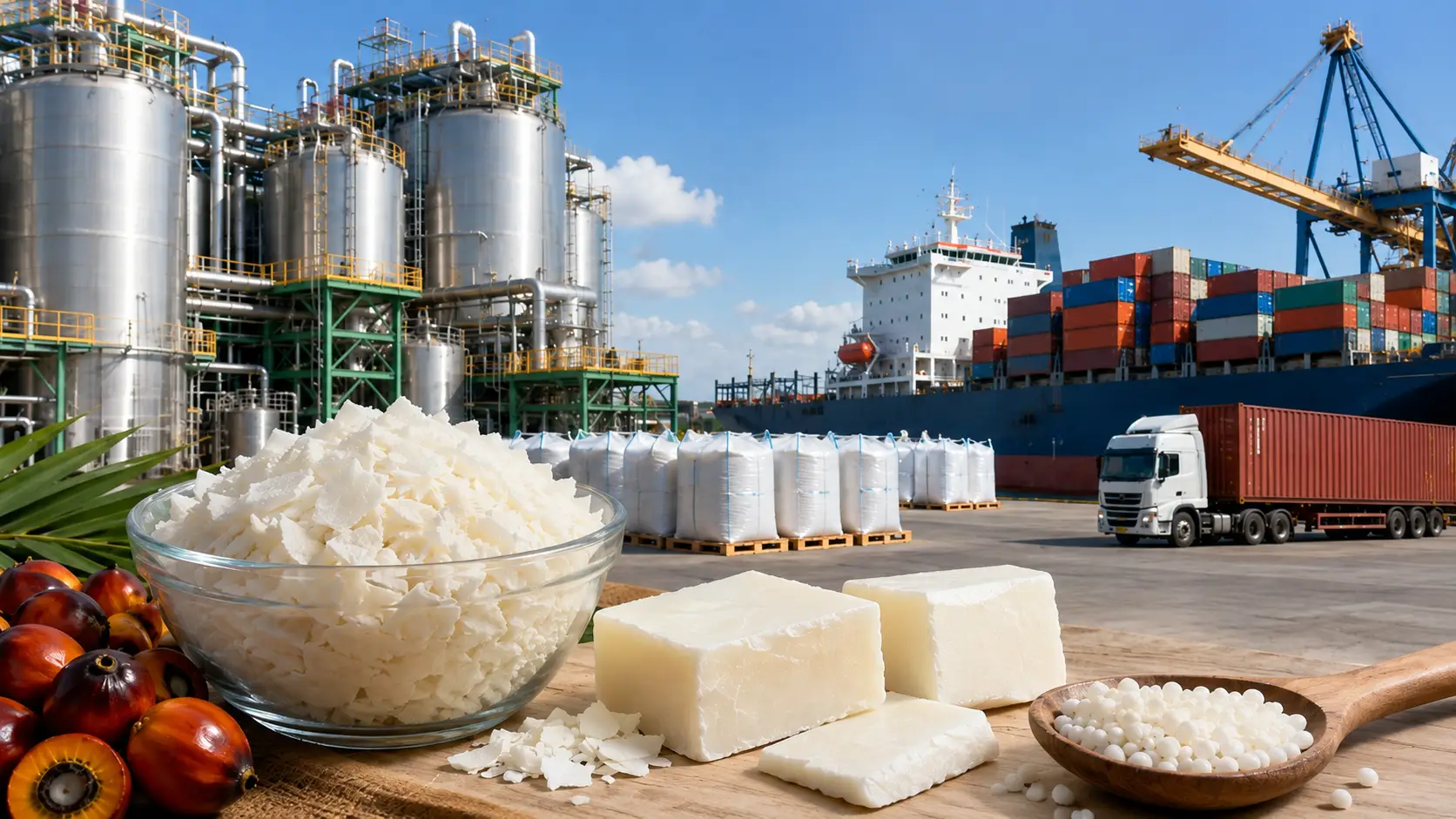
Table of Content
-
Introduction
-
The Refining Process: From Crude Palm Oil to RBD Palm Stearin
-
Key Specifications and Quality Parameters of RBD Palm Stearin
-
Global Supply Chain Dynamics for Palm Stearin
-
Industrial Applications and Benefits of RBD Palm Stearin
-
Market Trends and Future Outlook for Palm Stearin
-
Conclusion
Introduction
The global fats and oils industry relies heavily on the efficient processing and distribution of palm oil derivatives. Among these, RBD palm stearin stands out as a critical solid fraction used across food, oleochemical, and biofuel sectors. Understanding how refineries transform crude palm oil into this versatile product and manage its worldwide supply chain is essential for buyers, traders, and manufacturers. This article provides a comprehensive overview of the refining process, quality specifications, and the logistical networks that ensure consistent global availability of palm stearin.
As demand for structured fats and sustainable raw materials grows, the role of specialized refineries becomes increasingly important. From fractionation technology to storage and shipping, every step in the supply chain adds value and ensures that end-users receive a product meeting exacting industrial standards. This exploration will equip readers with the knowledge to navigate the market and appreciate the technical sophistication behind a seemingly simple commodity.
The Refining Process: From Crude Palm Oil to RBD Palm Stearin
The journey of RBD palm stearin begins with crude palm oil (CPO). Refineries employ a multi-stage process to convert CPO into refined, bleached, and deodorized (RBD) oil, which is then fractionated to separate the liquid olein from the solid stearin. The initial refining steps—degumming, neutralization, bleaching, and deodorization—remove impurities, free fatty acids, color pigments, and volatile compounds, resulting in a neutral, stable oil base suitable for fractionation.
Fractionation is the defining step for producing palm stearin. This controlled crystallization process cools the RBD palm oil under specific temperature and time parameters, allowing the higher-melting triglycerides to crystallize. These crystals are then separated from the liquid olein using membrane filter presses or dry fractionation methods. The resulting solid fraction, RBD palm stearin, has a higher melting point (typically 44-56°C) and a harder consistency, making it ideal for applications requiring solid fat content without hydrogenation.
Modern refineries integrate advanced process control systems to optimize yield and consistency. By adjusting cooling curves and filtration pressures, producers can tailor the iodine value and slip melting point of the stearin to meet specific customer requirements. This precision engineering is a hallmark of leading suppliers in the supply chain, ensuring that each batch of RBD palm stearin performs predictably in its intended application.
Key Specifications and Quality Parameters of RBD Palm Stearin
Quality consistency is paramount when trading RBD palm stearin globally. Buyers rely on standardized specifications to ensure the product fits their manufacturing processes. The most critical parameters include the slip melting point (SMP), iodine value (IV), free fatty acid (FFA) content, and color (Lovibond). A typical RBD palm stearin might have an SMP of 52-54°C, an IV of 32-36, and an FFA below 0.1%, indicating excellent stability and purity.
Beyond basic chemistry, physical properties like solid fat content (SFC) at various temperatures (e.g., 10°C, 20°C, 30°C, and 40°C) are crucial for applications such as margarine, shortening, and confectionery fats. The SFC profile dictates the product's plasticity, mouthfeel, and heat resistance. For oleochemical applications, specifications may focus on fatty acid composition and trace metal content, as these affect catalyst performance in downstream reactions like hydrogenation or esterification.
Reputable refineries provide detailed certificates of analysis (CoA) with every shipment, often adhering to international standards set by organizations like the Palm Oil Refiners Association of Malaysia (PORAM) or the Indonesian Palm Oil Association (GAPKI). These documents are vital for customs clearance and for end-users to verify that the palm stearin meets their contractual obligations. The ability to consistently meet tight specifications is a key differentiator for suppliers in the competitive global market.
Global Supply Chain Dynamics for Palm Stearin
The supply chain for RBD palm stearin is a complex network spanning production hubs in Southeast Asia (primarily Malaysia and Indonesia) to consumption centers in Europe, the Americas, Africa, and the Middle East. The journey from refinery to end-user involves multiple stakeholders: palm oil mills, refineries, fractionation plants, storage terminals, shipping lines, and logistics providers. Efficient coordination is essential to maintain product quality and delivery schedules.
Bulk shipping is the primary mode of transport for palm stearin. The product is typically loaded into specialized tankers equipped with heating coils to maintain the stearin in a molten state. Upon arrival at destination ports, it is stored in heated tanks before being transferred to road tankers or ISO containers for final delivery. Maintaining strict temperature control throughout this chain prevents solidification and contamination, preserving the product's integrity. Leading suppliers invest in global tank farm networks to ensure buffer stocks and supply security.
Market dynamics such as CPO price volatility, export tariffs, and sustainability certifications (e.g., RSPO) significantly influence the flow of RBD palm stearin. Buyers increasingly demand traceable, sustainable sources, prompting refineries to invest in segregated supply chains. The ability to offer certified sustainable palm stearin is becoming a prerequisite for many multinational buyers, adding another layer of complexity to the global supply chain.
Industrial Applications and Benefits of RBD Palm Stearin
RBD palm stearin is prized for its versatility and functional properties. In the food industry, it is a key ingredient for producing margarine, shortening, and frying fats. Its high solid fat content provides structure and stability, making it ideal for puff pastry, pie crusts, and creaming applications. Unlike hydrogenated fats, it contains no trans fatty acids, offering a healthier alternative for solid fat formulations. Confectionery manufacturers use it as a cocoa butter equivalent (CBE) substitute or extender, taking advantage of its sharp melting profile near body temperature.
Beyond food, palm stearin is a cornerstone of the oleochemical industry. It serves as the primary feedstock for manufacturing fatty acids, fatty alcohols, glycerol, and soaps. In the production of metallic stearates (used as lubricants and stabilizers in plastics and rubber), palm stearin provides consistent chain length distribution. The biodiesel sector also consumes palm stearin as a low-cost feedstock for producing methyl esters, particularly in regions with supportive blending mandates.
The benefits of using RBD palm stearin are numerous: excellent oxidative stability, consistent quality, competitive pricing compared to animal fats, and a well-established global infrastructure. Its high melting point makes it ideal for warm-climate applications and for products requiring heat resistance. For manufacturers seeking a reliable, functional, and cost-effective solid fat, palm stearin remains a top choice across multiple industries.
Market Trends and Future Outlook for Palm Stearin
The global market for palm stearin is experiencing steady growth, driven by rising demand for processed foods in developing economies and the expansion of the oleochemical industry. According to industry reports, the market is projected to grow at a CAGR of 3-5% over the next five years, with Asia-Pacific and Africa emerging as key consumption hubs. The shift away from trans fats in North America and Europe continues to boost demand for naturally solid fats like palm stearin.
Sustainability and regulatory pressures are shaping the future of the supply chain. The European Union's Deforestation Regulation (EUDR) is forcing producers to provide geolocation data and prove that palm stearin is not linked to deforestation. This is driving investment in traceability technologies such as blockchain and satellite monitoring. Refineries that can offer fully traceable, certified sustainable RBD palm stearin will have a competitive advantage in premium markets.
Technological advancements in fractionation are also improving yields and product customization. New dry fractionation processes with higher efficiency allow refineries to produce stearin with narrower melting ranges, opening up specialized applications in pharmaceuticals and personal care. As the industry evolves, collaboration between refineries, traders, and end-users will be crucial to meeting the dual challenges of sustainability and performance. The future of palm stearin lies in innovation and responsible sourcing.
Conclusion
The journey of RBD palm stearin from crude palm oil to a globally traded industrial commodity is a testament to the sophistication of modern refining and logistics. Through precise fractionation and rigorous quality control, refineries deliver a product that serves indispensable roles in food, oleochemical, and energy applications. Understanding the supply chain—from production in Southeast Asia to delivery worldwide—empowers buyers to make informed decisions and secure reliable, high-quality supplies.
Disclaimer: This article is intended for informational and market insight purposes only. It does not constitute technical, safety, or professional advice regarding the handling, storage, or application of RBD palm stearin. Readers are strongly advised to independently verify all information with qualified experts, consult official documentation such as Material Safety Data Sheets (MSDS/SDS), or contact our team for guidance on specific applications and regulatory compliance. The author and platform assume no liability for any decisions or actions taken based on the content provided.
Tags
Most Popular Insights
Most Popular Insights
Don't miss out on our updates!
Subscribe to our newsletter now
We're committed to your privacy. Tradeasia uses the information you provide to us to contact you about our relevant content, products, and services. For more information, check out our privacy policy.